
Canincunca Chapel: Murals, Tickets and Visitor Guide

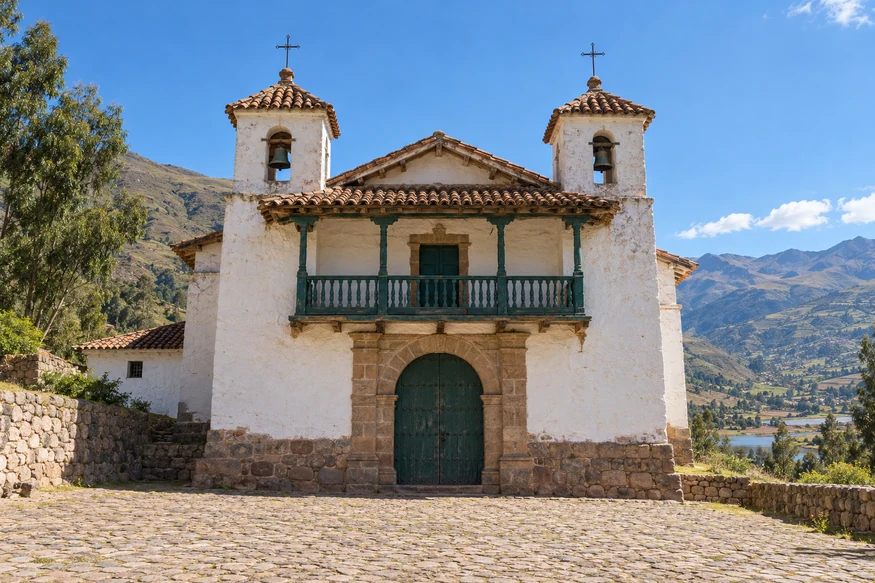
Canincunca Chapel is a small Andean Baroque landmark south of Cusco, celebrated for interior murals that combine Christian imagery with flowers, birds, fruit and geometric motifs inspired by the Andes. Officially known as the Chapel of the Purified Virgin of Canincunca, it forms part of the Andean Baroque Route with Andahuaylillas and Huaro.
What Is Canincunca Chapel?
Canincunca is a seventeenth-century rural chapel in Huaro District, Quispicanchi Province. Its whitewashed adobe exterior appears restrained, while the interior is covered with mural painting and gilded details that express the meeting of European religious art and Andean visual traditions.
The chapel remains a place of worship and community identity. Visitors should approach it as a living sacred site rather than only as a sightseeing stop.
Where Is Canincunca?
The chapel stands on the road between Cusco and Puno, near Urcos and the eastern end of the South Valley. Peru’s official tourism inventory places it roughly 42 kilometers south of Cusco at approximately 3,270 meters above sea level.
The official access record estimates about 43 kilometers and 50 minutes by private vehicle from central Cusco under favorable conditions. Traffic and planned stops can make the journey longer.
Why Is Canincunca Important?
Canincunca is valued for the unusual completeness of its painted decoration and for the way local flora, fauna and textile-like patterns appear within a Christian building. It was declared part of Peru’s National Cultural Heritage in 1974.
The chapel is also included among the Rural Temples of Cusco submitted to UNESCO’s Tentative List in 2019. Tentative-list status is not the same as inscription as a World Heritage Site.
History of Canincunca Chapel
The chapel was built in the seventeenth century over an earlier Wari ceremonial setting. Archaeological work has identified evidence of pre-Hispanic ritual and burial use, showing that the location held importance before the colonial building existed.
Repairs followed the 1950 Cusco earthquake, and a broader restoration took place during the 1970s with support connected to Peru’s cultural authorities and UNESCO. Conservation work has continued in later periods.
Canincunca Murals and Gold-Leaf Details
Paintings from the seventeenth and eighteenth centuries cover walls and sections of the ceiling. Floral bands, fruit, birds and geometric designs resemble woven textiles, while gold-leaf ribbons frame parts of the composition.
Notable details described by the official inventory include Saints Peter and Paul in the upper choir and Andean animals such as cranes and vizcachas along the painted lower walls.
Architecture of the Chapel
The structure consists principally of a single nave with a sacristy, a small U-shaped upper choir and twin bell towers. Stone foundations support adobe walls, while a traditional timber roof carries clay tiles.
The contrast between the modest exterior and the richly treated interior is central to the visitor experience. Do not touch painted surfaces, woodwork or devotional objects.
Canincunca Chapel Tickets
The official tourism inventory updated in 2025 lists admission of S/10 for Peruvian adults, S/18 for foreign adults and S/10 for students. Cusco residents showing identification and children up to ten were listed as free.
Prices, ticket combinations and eligibility rules can change. Confirm the current Andean Baroque Route ticket directly before leaving Cusco.
Canincunca Chapel Opening Hours
The current official inventory lists visiting hours from 8:30 a.m. to 4:30 p.m. throughout the year, with entry described as semi-restricted and subject to presentation of a ticket or prior permission.
Religious services, conservation work and local events can affect access. Your driver or guide should reconfirm the opening time on the day of travel.
How to Get to Canincunca from Cusco
Private transportation is the simplest choice because the chapel is normally combined with several dispersed stops. It also allows the route to adapt if access times change.
Choose the South Valley private transfer for a flexible vehicle plan, or the South Valley Cusco tour when you want guiding and a coordinated cultural itinerary.
Canincunca on the Andean Baroque Route
The route connects Canincunca with the Church of San Pedro Apóstol in Andahuaylillas and the Church of San Juan Bautista in Huaro. Together, the three sites show different expressions of mural painting, architecture and community devotion.
A complete route should allow meaningful time inside each temple rather than treating them as quick exterior photo stops.
Canincunca vs Huaro Church
| Factor | Canincunca Chapel | Huaro Church |
|---|---|---|
| Main appeal | Textile-like murals, flora and fauna motifs | Dramatic murals by Tadeo Escalante |
| Building type | Small rural chapel | Larger parish church |
| Setting | Near the Cusco–Puno road and Urcos | In the town of Huaro |
| Best approach | Visit both as part of the Andean Baroque Route | |
The sites complement each other and should not be reduced to a competition over which has the richer interior.
Canincunca with Urcos and Raqchi
Urcos is nearby and can provide a practical stop for services or a view of the lagoon. Travelers continuing farther south may also read the guide to Raqchi, but Raqchi requires substantially more road time and should be planned as part of a longer itinerary.
Do not overload a single day with every attraction between Cusco and the Vilcanota Valley.
Accessibility and Visitor Conditions
The official inventory records a Tur4all accessibility distinction awarded in 2025. Individual requirements still vary, and a historic chapel can include uneven paving, thresholds or restricted areas.
Contact the route in advance to confirm vehicle access, steps, seating and restroom arrangements for the specific day.
Responsible Heritage Travel
Dress respectfully, keep voices low and silence your phone. Follow all photography restrictions and never use flash when it is prohibited. Do not touch walls, paintings, altarpieces or sculptures.
Purchase tickets through authorized channels and respect closures related to worship or conservation. These measures help protect fragile art and support the communities responsible for the route.
Frequently Asked Questions
Is Canincunca Chapel worth visiting?
Yes for travelers interested in Andean Baroque art, mural painting, rural churches or a deeper South Valley itinerary.
Can you visit Canincunca, Huaro and Andahuaylillas together?
Yes. They form the core South Valley section of the Andean Baroque Route and are best visited with coordinated transport.
How long do you need at Canincunca?
Allow approximately 30 to 45 minutes for a guided interior visit, excluding transport, ticketing and any access delay.